

Sub-Saharan Africa
Harnessing potential for a prosperous tomorrow
The Working Group Sub-Saharan Africa, analysing political stability, security challenges, and economic development, explores regional conflicts, counterterrorism efforts, and foreign influence in Sub-Saharan Africa. It assesses governance trends, resource security, and military cooperation. Monthly briefings present factual analyses and visualisations to illustrate the region's evolving role in international security policy.
Limited Statehood
Limited Statehood: How Armed Groups Fill Governance Gaps in Sub-Saharan Africa When state authority is weak or absent, armed groups may seize the opportunity not only to fight national authorities, but also to create rules, tax civilians, regulate behaviour, impose their own concept of justice, a…
The Crisis in Cabo Delgado: Why Mozambique Matters
A forgotten humanitarian crisis with deepening roots Rwanda’s intervention is strategically self-serving, not purely altruistic A new, fragmented security order is emerging in Africa
Anglophone Conflict in Cameroon
Historical roots driving a neglected conflict Structural silencing keeps the crisis hidden International complicity dims the spotlight further
U.S. Intervention in Nigeria’s Security Crisis
The Christmas Day 2025 US missile strike was far more contested than the official narrative suggested The US had multiple motivations beyond counterterrorism Military action alone cannot resolve Nigeria’s security crisis

The advance of the Hydra
How and why jihadist violence spread to Benin and Togo — Structural weaknesses across the Sahel created power vacuums that terrorist groups like JNIM exploited. Why local populations are vulnerable to recruitment. As the state is largely absent, Jihadist groups fill this gap by acting as alternat…
Managing Instability in Senegal
Why the Casamance conflict began — Deep-rooted colonial history created ethnic, religious, and cultural divisions between the Joola-majority Casamance region and the rest of Senegal. Why the conflict has neither escalated nor resolved over 40+ years . What needs to happen for resolution — The ar…
Strategic Engagement
Main Question: How can young professionals successfully enter and influence the highly competitive United Nations ecosystem? Argument: Entry requires a “Show Up” mindset that pairs professional-grade language skills with strategic branding, where personal experiences are packaged to fill specific…
Jihadist expansion across borderlands in the Sahel
JNIM and ISSP are expanding into coastal West Africa to control illicit trade. Regional stability now depends on the new AES Unified Force’s ability to integrate operations with local security and overcome tensions to coordinate regionally.
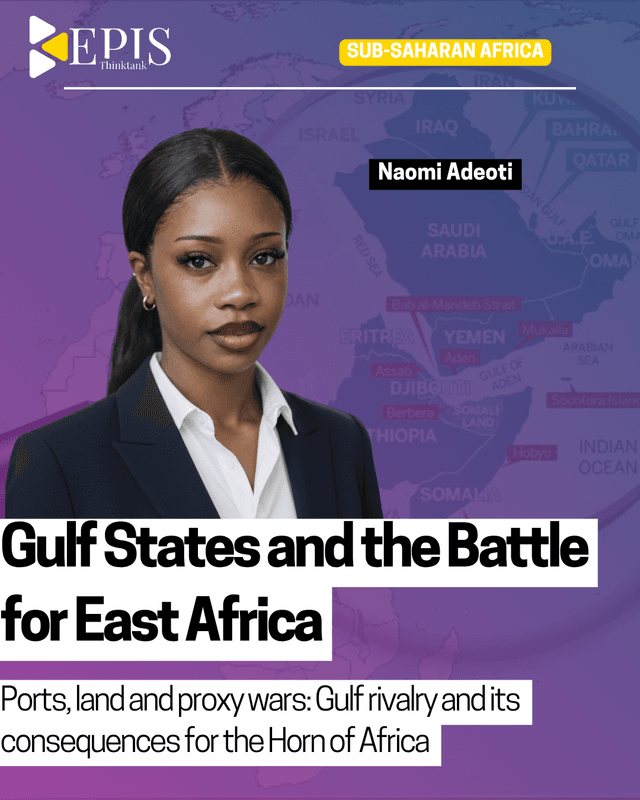
Gulf States and the Battle for East Africa
Gulf states have become the Horn of Africa’s most consequential external actors — but how is their influence actually operating? Infrastructure development, farmland acquisition, and security partnerships combine into a model of embedded influence that accumulates leverage over time while bypassi…

Interview with Lola Aworanti-Ekugo
How can the Global South advance in digital trade and AI? Effective digital trade requires inclusive policies, public-private collaboration, and support for scalable local innovations. With strategic partnerships, infrastructure investment, and global openness, African digital solutions can compe…
Maternal Mortality as Foreign Policy Failure
Why is maternal health not treated as a strategic foreign policy priority? This report argues that Sudan’s maternity crisis exposes systemic failures in humanitarian and foreign policy frameworks that marginalise women’s reproductive care. Maternal deaths in conflict are predictable and preventab…
Justice Beyond the Courtroom in Africa
In what ways does transnational litigation function as both a challenge to and a reproduction of corporate impunity in the strategies of environmental justice movements in Africa? African movements use courts to hold transnational corporations accountable, but legal action can both contest and re…
South Sudan’s Potential Descent into Crisis
The main question is, how can history help us better understand and put the current 2025-2026 crisis into context. South Sudan’s stability is undermined by historic ethnic grievances, but also important to note but often left out in the discourse is by the extractive resources economic model tha…
Hidden Corruption in Supply Chains
-Main question: Why does corruption persist in global supply chains despite existing international standards and corporate compliance tools? -Argument: Structural governance gaps, information asymmetries and fragmented regulation enable systemic, network‑based corruption that escapes traditional …
China and Human Rights Protection in Ethiopia
This article asks to what extent China’s principle of non-interference contributes to the weakening of international human rights pressure in Ethiopia. It argues that China’s extensive economic investments, creditor leverage, and diplomatic support, without governance or human rights conditions, …
All Theory, No Practice?
Ever since its genesis, impartiality has epitomised a core principle of UN peacekeeping. However, developments towards robust peacekeeping, like the implementation of MONUSCO’s Force Intervention Brigade, catalysed doubts about whether the UN would be able to uphold its self-imposed commitment to…

Water Diplomacy and River Basin Organisations
This article discusses how unilateral mega-infrastructure projects generate conditions of water stress and asks whether river basin organisations function as effective peacebuilding apparatus in the Eastern Nile Basin. This article considers the institutional design and technological mechanisms t…

Breaking Diplomatic Norms
Israel’s recognition of Somaliland at the end of 2025, Somalia’s territorial integrity, and decades of international consensus. This unilateral move reframes Somaliland’s three-decade independence as legitimate dissolution rather than illegal secession. The brief argues that state recognition is …
THE WAR IN SUDAN
The article examines how authoritarian collapse, elite division, and foreign proxies shape Sudan’s war. Using neo-realist and political marketplace theories, it argues that state breakdown allowed external actors to transform internal struggles into a regionalized conflict fueled by resource netw…
Post-Election Human Rights Violations in Tanzania
To what extent do post-election events in Tanzania constitute violations of international human rights law? Evidence from international organisations and civil society indicates breaches of the rights to life, liberty, due process, expression, and political participation. Facts suggest serious no…